XAUUSD
XAUUSD Lot Size: What 0.01 Lot of Gold Is Worth, and How to Size Every Trade
On most retail platforms, 1.0 lot of XAUUSD is 100 troy ounces of gold. That makes the math simple: a $1 move in the gold price is worth $100 on 1.0 lot, $10 on 0.10 lot and $1 on 0.01 lot. The right XAUUSD lot size is the one where your stop distance in dollars, times that value, equals the money you decided to risk.
This Value guide gives you the value of every common gold lot per move, the one line formula, ready lot size tables for $500 to $10,000 accounts, and a shortcut for 0.01 lot traders. Every number uses the same preset as the free SIWAI XAUUSD lots calculator, so you can rerun any row with your own stop in seconds.
What one lot of gold actually is
A forex lot is 100,000 units of currency. A gold lot is a weight. Spot gold is quoted in US dollars per troy ounce, and the standard retail CFD contract copies the exchange contract: CME Group's COMEX gold futures contract is 100 troy ounces, and its gold product lesson also lists a 10 ounce micro contract. A troy ounce is about 31.1 grams (see troy weight), slightly heavier than the ounce on a kitchen scale.
So on a 100 ounce contract:
- 1.00 lot (standard) controls 100 ounces
- 0.10 lot (mini) controls 10 ounces
- 0.01 lot (micro) controls 1 ounce
That is the whole trick. Once you know how many ounces you hold, profit and loss is just ounces times the dollar move. A clean breakout through resistance can travel several dollars in one candle, which is why gold sizing has to start from the stop and not from what feels like a small lot.
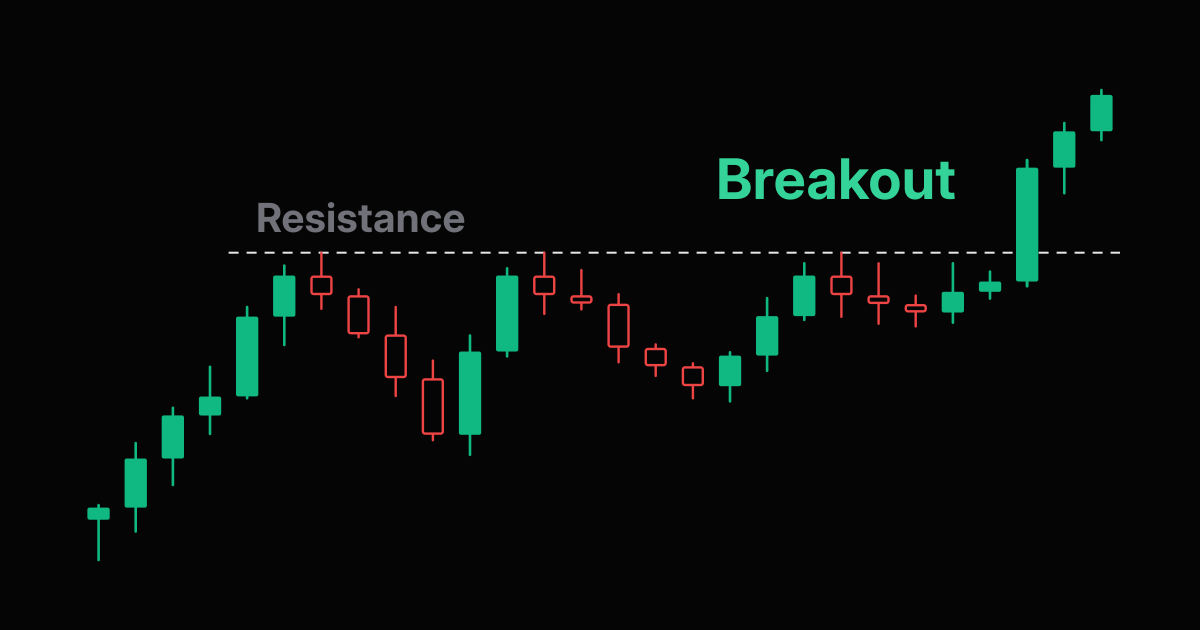
What 0.01, 0.10 and 1.0 lot of gold are worth per move
The SIWAI preset uses a point of $0.01 (the smallest step on a two decimal gold quote) and values 1.0 lot at $1 per point. That is the same as $100 per $1 move. The table scales in a straight line.
| Lot size | Ounces | $0.01 move | $0.10 move | $1 move | $5 move | $10 move |
|---|---|---|---|---|---|---|
| 0.01 | 1 | $0.01 | $0.10 | $1 | $5 | $10 |
| 0.05 | 5 | $0.05 | $0.50 | $5 | $25 | $50 |
| 0.10 | 10 | $0.10 | $1 | $10 | $50 | $100 |
| 0.50 | 50 | $0.50 | $5 | $50 | $250 | $500 |
| 1.00 | 100 | $1 | $10 | $100 | $500 | $1,000 |
Read it as "ounces times dollars." A 0.05 lot is 5 ounces, so a $5 move is $25. Spread, commission and overnight swap come on top of these figures, so the real cost of a losing trade is always a little larger than the table.
Pips, points and cents: the gold confusion
Most sizing mistakes on gold come from one word. Traders say "pip" and mean three different things:
| What people call a pip | Price move | Value on 1.0 lot | A $5 stop equals |
|---|---|---|---|
| Point or tick (two decimal quote) | $0.01 | $1 | 500 points |
| "Pip" as ten cents | $0.10 | $10 | 50 pips |
| One full dollar | $1.00 | $100 | 5 dollars |
All three rows describe the same $5 stop and the same dollar risk. The danger is mixing them: entering "50" in a calculator that expects points gives you a $0.50 stop and a lot size ten times too large. The fix is to think in dollars of gold price first, then convert. SIWAI uses points of $0.01, which is why the XAUUSD calculator's default stop of 300 points means a $3.00 move.
The XAUUSD lot size formula
Position sizing always starts from risk money, as Investopedia's position sizing guide explains. For gold on a 100 ounce contract it reduces to one line:
Risk money = account equity × risk percent
Risk per 1.0 lot = stop distance in dollars × 100
Lot size = risk money ÷ risk per 1.0 lot
Worked example: $2,500 account, 1% risk, long gold with a $4 stop.
- Risk money: $2,500 × 1% = $25
- Risk per 1.0 lot: $4 × 100 = $400
- Lot size: $25 ÷ $400 = 0.0625, rounded down to 0.06 lot
- Check: 0.06 lot is 6 ounces, and 6 × $4 = $24 at risk (0.96% of the account)
Always round down to your broker's volume step. Rounding up quietly turns a 1% rule into a 1.04% or 1.1% rule, and that drift adds up over a losing streak. Place the stop where the chart says the idea is wrong, then let the formula decide the lot. Never the other way around.
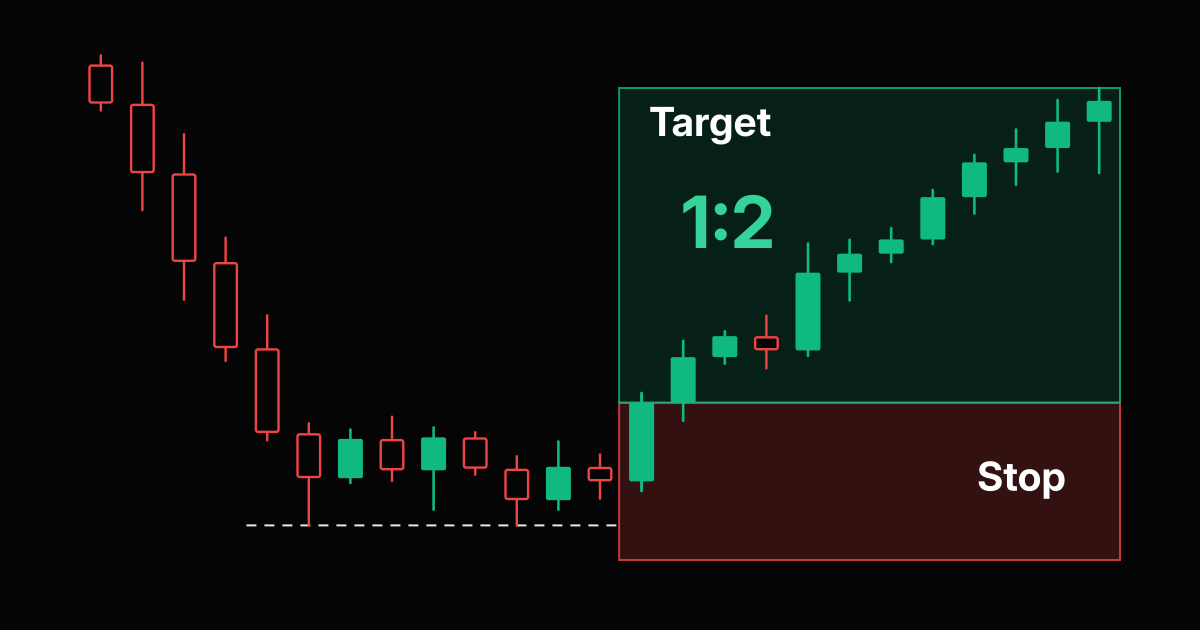
Gold lot size tables for $500 to $10,000 at 1% risk
Each cell is the formula above, rounded down to a 0.01 volume step. "Below 0.01" means the smallest common order would risk more than 1%. Stops are in dollars of gold price ($5 = 500 points on the SIWAI preset).
| Account | 1% risk | $2 stop | $5 stop | $10 stop | $20 stop |
|---|---|---|---|---|---|
| $500 | $5 | 0.02 | 0.01 | Below 0.01 | Below 0.01 |
| $1,000 | $10 | 0.05 | 0.02 | 0.01 | Below 0.01 |
| $2,500 | $25 | 0.12 | 0.05 | 0.02 | 0.01 |
| $5,000 | $50 | 0.25 | 0.10 | 0.05 | 0.02 |
| $10,000 | $100 | 0.50 | 0.20 | 0.10 | 0.05 |
Notice the pattern: double the stop and the lot halves. A $20 stop on a $1,000 account would need 0.005 lot, which most platforms will not accept. For smaller accounts and more instruments side by side, see How Many Lots Can I Trade With $100, $500 or $1,000?
Rerun any row with your exact stop on the XAUUSD lots calculator, or use the position size calculator if you trade gold next to forex pairs on the same risk rule.
The 0.01 lot shortcut: your stop in dollars equals your risk
Because 0.01 lot is exactly 1 ounce, a $1 move costs $1. So on the minimum lot, the widest stop you can afford in gold dollars is simply your risk money in account dollars.
| Account | 1% risk | Widest stop at 0.01 lot | In SIWAI points |
|---|---|---|---|
| $500 | $5 | $5 | 500 |
| $1,000 | $10 | $10 | 1,000 |
| $2,500 | $25 | $25 | 2,500 |
| $5,000 | $50 | $50 | 5,000 |
If the chart needs a wider stop than that, the lot cannot shrink any further. You have three honest choices: wait for a tighter structure, knowingly accept a larger risk percent, or skip the trade. Shrinking the stop just to fit 0.01 lot usually means getting stopped out by normal gold noise.
0.5%, 1% or 2%: how risk percent changes gold lot size
Same $5,000 account, same $5 stop, three risk rules. Lot size moves in direct proportion to the percent.
| Risk per trade | Risk money | Lot size ($5 stop) | Loss after 5 losers in a row |
|---|---|---|---|
| 0.5% | $25 | 0.05 | $125 (2.5%) |
| 1% | $50 | 0.10 | $250 (5%) |
| 2% | $100 | 0.20 | $500 (10%) |
The last column uses fixed dollar risk on the starting balance to keep the math readable. Losing streaks happen to every strategy, and gold can jump through a stop around big data releases (our CPI day chart setups show why event days need extra care). A smaller percent buys you more attempts.
Lot size controls the loss. The payoff decides whether the trade is worth taking. Before you size, check that the distance to target is at least a multiple of the distance to stop with the risk reward calculator and our guide on how to calculate risk reward ratio.
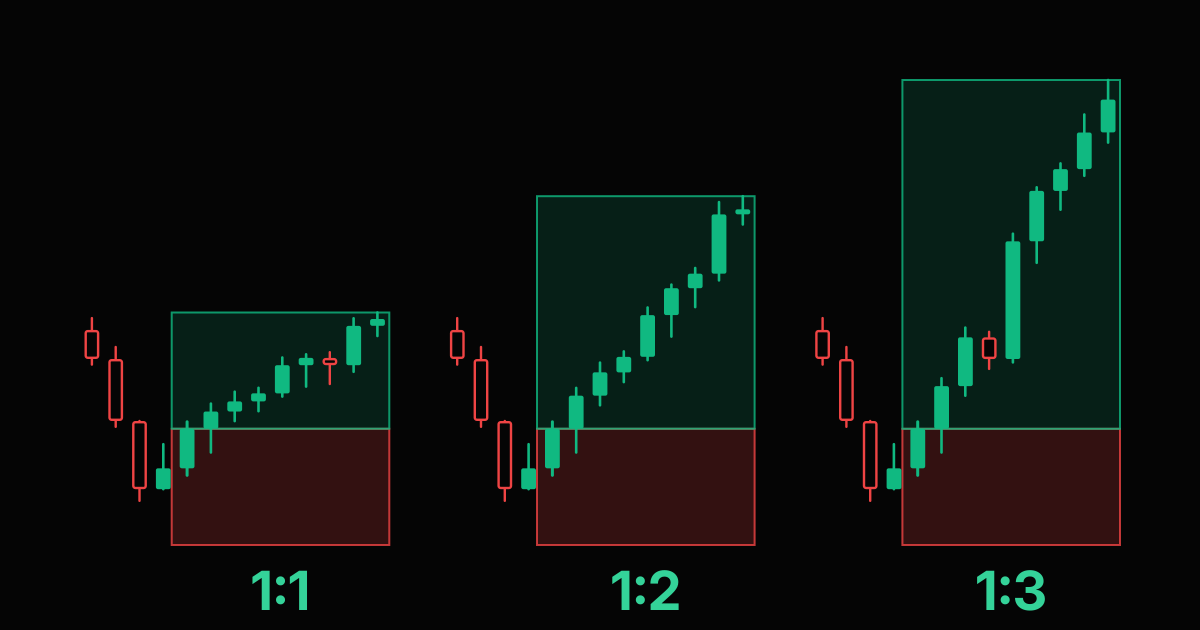
Check your broker before the first live gold order
A 100 ounce lot is common, not universal. In MetaTrader, right click the symbol in Market Watch and open Specification. The MetaTrader 5 help lists the fields that matter:
- Contract size: ounces per 1.0 lot. If it says 10 instead of 100, every value in this guide is ten times smaller per lot.
- Digits and tick size: two digits means a $0.01 step. Three digits means a $0.001 step, so "points" are ten times smaller.
- Tick value: money per tick on 1.0 lot. It confirms the math above in one number.
- Minimal volume and volume step: the smallest order and the increment. This decides when a table cell is really "below 0.01."
Leverage does not change any of these numbers. It only changes the margin your broker holds. Margin is roughly lots × contract size × gold price ÷ leverage, so a 0.10 lot always controls 10 ounces of exposure whatever the leverage setting. Your dollar risk per move is fixed by ounces, not by leverage.
Gold also moves with the dollar. If you hold gold next to a USD pair, check the live gold vs DXY correlation so you do not stack the same dollar theme twice (our currency correlation guide explains how). Silver traders can use the XAGUSD lots calculator, which uses a different contract size.
Frequently Asked Questions
How much is 0.01 lot of gold worth?
On the common 100 ounce contract, 0.01 lot of XAUUSD is 1 troy ounce. Every $1 move in the gold price changes your profit or loss by $1, and every $0.01 tick changes it by $0.01, before spread, commission and swap.
How do I calculate lot size for XAUUSD?
Multiply account equity by your risk percent to get risk money. Multiply your stop distance in dollars of gold price by 100 to get the risk of 1.0 lot. Divide risk money by that number and round down to your volume step. Example: $25 risk and a $4 stop gives $25 divided by $400, which is 0.06 lot after rounding down.
What lot size should I use for gold with a $1,000 account?
At 1% risk you have $10 to lose. With a $5 stop that is 0.02 lot, with a $10 stop it is 0.01 lot, and anything wider than $10 needs less than 0.01 lot, which most brokers will not accept. Let the stop decide, not the account size.
How many pips is a $1 move in gold?
It depends on the definition. If a point or pip is $0.01, a $1 move is 100 points. If a pip is $0.10, it is 10 pips. SIWAI calculators use points of $0.01, so a $3.00 stop is 300 points. Convert to dollars of gold price first to avoid sizing errors.
Is 1 lot of gold always 100 ounces?
No. 100 troy ounces matches the standard COMEX gold contract and is the most common retail setting, but some brokers use other contract sizes. Check Contract size and Tick value in the symbol Specification on your platform before trading live.
Does leverage change my gold lot size?
Leverage changes how much margin your broker holds, not how much you lose per dollar move. A 0.10 lot is 10 ounces of exposure at any leverage, so size from your stop and risk percent, then check that margin fits.
Risk Disclaimer: Trading stocks, options, futures, forex, commodities, and cryptocurrencies involves substantial risk of loss and is not suitable for every investor. Past performance does not guarantee future results. This article is for educational purposes only and does not constitute financial advice. You should carefully consider your financial situation and risk tolerance before trading. Never trade with money you cannot afford to lose. Gold contract sizes, tick values and minimum volumes vary by broker. Confirm the Specification on your platform before sizing a live order.