forex
How to Calculate Lot Size in Forex, With Worked Examples for EURUSD, GBPJPY and USDJPY
Lot size is the lever that turns a stop distance into a dollar amount. Get it wrong and a normal 30 pip pullback can wipe out a week of gains. Get it right and every trade risks the same fraction of your account, no matter which pair you trade.
This guide shows how to calculate lot size in forex from first principles: what a standard, mini, and micro lot mean, how pip value changes by pair, and worked examples for EURUSD, GBPJPY, and USDJPY using the same risk rule. The math matches the free SIWAI lots calculator.
What is a lot in forex
A lot is a standardized trade size. In retail forex, a standard lot is 100,000 units of the base currency, a mini lot is 10,000 units (0.1 lot), and a micro lot is 1,000 units (0.01 lot). Those conventions are widely used on MetaTrader style platforms. Investopedia's lot definition and BabyPips' lots and leverage lesson cover the same sizes. Always confirm your broker's contract size in the symbol specification before you trade.
Common retail forex lot sizes
Standard lot (1.0): 100,000 units of base currency
Mini lot (0.1): 10,000 units
Micro lot (0.01): 1,000 units
The lot number you type in the order ticket multiplies every pip of movement. On EURUSD, 1.0 lot moves about $10 per pip for a USD account. The same 1.0 lot on a JPY pair moves a different dollar amount because the quote currency and the exchange rate change the conversion.
How pip value works for EURUSD, GBPJPY and USDJPY
A pip is the standard price increment traders use for forex. For most pairs quoted to four decimals, one pip is 0.0001. For JPY pairs, one pip is 0.01. BabyPips explains the convention in pips and pipettes, and Investopedia's pip definition matches it. Pipettes are the next digit of precision (0.00001 or 0.001) and do not change the lot formula if you keep stops in whole pips.
For a USD account, pip value per 1.0 lot is:
Pip value (quote currency) = pip size × contract size
Then convert that amount into your account currency if the quote is not USD
EURUSD is the clean case. Pip size is 0.0001 and the quote is USD, so for 1.0 lot (100,000 units): 0.0001 × 100,000 = $10 per pip. Mini lots are $1 per pip. Micro lots are $0.10 per pip. You can cross check this on a pip calculator.
USDJPY and GBPJPY quote in yen, so the pip lands in JPY first. Pip size is 0.01, so for 1.0 lot the pip is worth 0.01 × 100,000 = 1,000 JPY. To get USD, divide by the USDJPY rate. Using the European Central Bank reference via Frankfurter on 2026-10-01, USDJPY was 157.98, so 1,000 ÷ 157.98 ≈ $6.33 per pip per 1.0 lot. That rate moves every session, so treat $6.33 as the worked example for that day, not a permanent constant. The USDJPY lots calculator and GBPJPY lots calculator refresh the conversion when you size the trade.
Pip value per 1.0 lot (USD account, example rate USDJPY 157.98 on 2026-10-01)
EURUSD: $10.00 per pip
USDJPY: about $6.33 per pip
GBPJPY: about $6.33 per pip (JPY quote converted via USDJPY)
JPY pair values change when USDJPY moves. Recalculate before sizing.
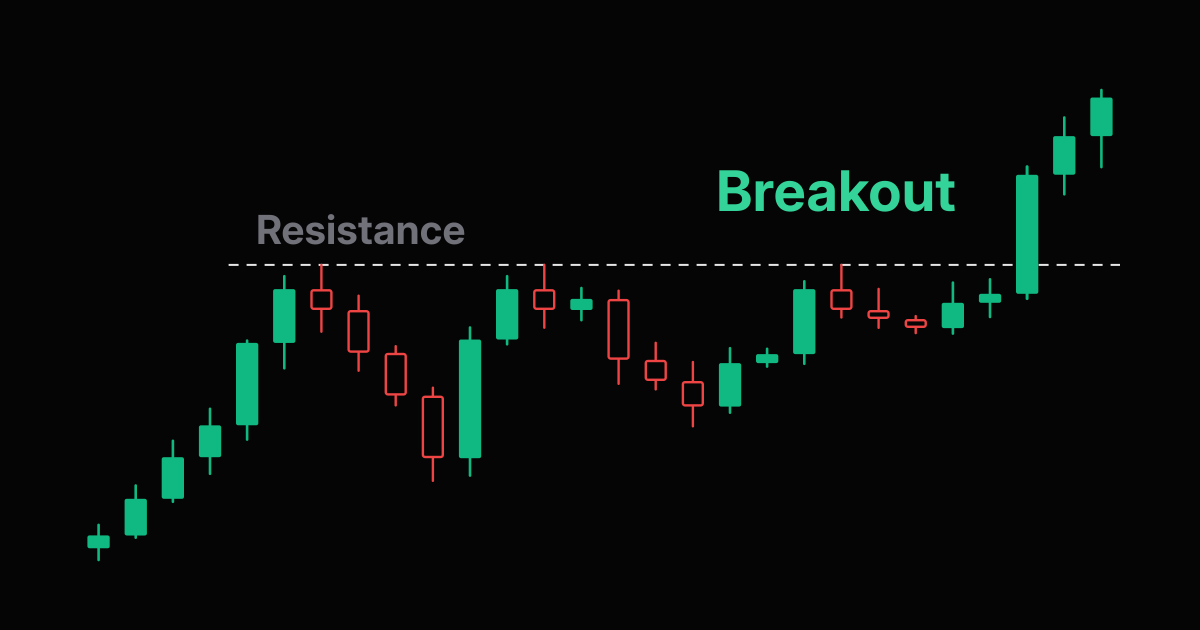
The lot size formula from account risk
Start from how much of the account you are willing to lose if the stop is hit. Convert that into dollars, measure the stop in pips, then divide by the dollar risk of one lot across that stop.
Risk money = account equity × risk percent
Risk per 1.0 lot = stop distance (pips) × pip value per 1.0 lot
Lot size = risk money ÷ risk per 1.0 lot
That is the same formula the position size calculator and the pair lots calculators use. Widen the stop and the lot size falls. Raise the risk percent and the lot size rises. Never reverse the order: pick the stop from the chart first, then size the lot to the risk rule. If you pick the lot first, you are guessing, not managing risk.
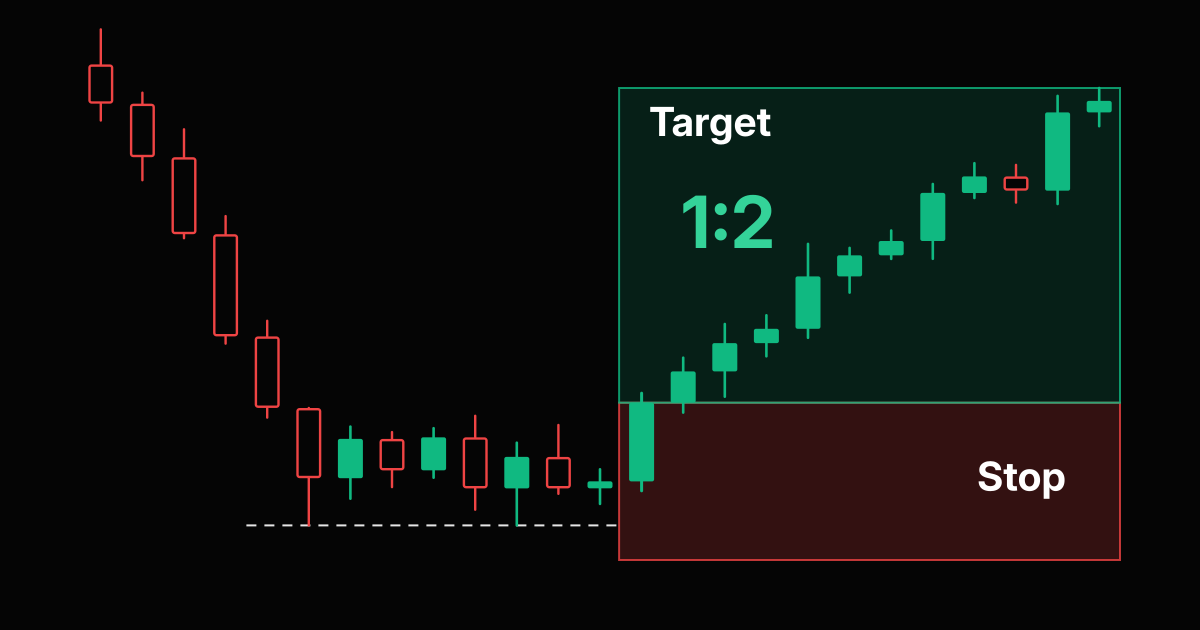
Worked example: EURUSD lot size
Account equity: $10,000. Risk rule: 1% per trade, so risk money is $100. Setup: long EURUSD with a 50 pip stop. Pip value at 1.0 lot: $10.
- Risk per 1.0 lot: 50 × $10 = $500
- Lot size: $100 ÷ $500 = 0.2 lots
- That is 2 mini lots, or 20 micro lots
EURUSD summary
Risk: 1% of $10,000 = $100
Stop: 50 pips
Pip value: $10 per pip per 1.0 lot
Lot size: 0.2
Run the same numbers in the EURUSD lots calculator to confirm before you send the order.
Worked example: USDJPY lot size
Same account and risk: $10,000 and 1% ($100). Same 50 pip stop on USDJPY. Using USDJPY at 157.98 (Frankfurter, 2026-10-01), pip value at 1.0 lot is about $6.33.
- Risk per 1.0 lot: 50 × $6.33 ≈ $316.50
- Lot size: $100 ÷ $316.50 ≈ 0.32 lots
USDJPY summary (rate 157.98)
Risk: $100
Stop: 50 pips
Pip value: about $6.33 per pip per 1.0 lot
Lot size: about 0.32
Notice the lot size is larger than the EURUSD example for the same dollar risk and the same pip stop. That is because each pip is worth less in USD on USDJPY at this rate. The risk in dollars is still $100 if the stop is hit. Use the USDJPY calculator so you do not hard code a stale rate.
Worked example: GBPJPY lot size
GBPJPY is a cross quoted in yen. For a USD account, the pip still converts through USDJPY the same way as USDJPY itself when the quote is JPY: 1,000 JPY per pip per 1.0 lot, divided by USDJPY. At 157.98 that is again about $6.33 per pip per 1.0 lot.
Keep the same $100 risk and a 50 pip stop:
- Risk per 1.0 lot: 50 × $6.33 ≈ $316.50
- Lot size: $100 ÷ $316.50 ≈ 0.32 lots
GBPJPY summary (via USDJPY 157.98)
Risk: $100
Stop: 50 pips
Pip value: about $6.33 per pip per 1.0 lot
Lot size: about 0.32
Cross pairs can move farther in pips than majors on the same news. If your chart stop needs to be 80 pips instead of 50, recalculate. At $6.33 per pip, an 80 pip stop risks about $506.40 per 1.0 lot, so lot size for $100 risk is about 0.20. The GBPJPY lots calculator and the GBPUSD lots calculator help you compare related dollar and yen expressions of sterling risk.
Common lot sizing mistakes
- Sizing from conviction instead of the stop. A strong setup does not change the math. Wider stops need smaller lots for the same risk.
- Using EURUSD pip value on every pair. JPY pairs and crosses convert differently. Recalculate or use the pair calculator.
- Ignoring account currency. If your account is EUR or GBP, convert pip value into that currency before dividing.
- Forgetting the risk reward filter. Lot size controls loss size. It does not make a poor target worth taking. Check how to calculate risk reward ratio before you size.
- Copying someone else's lot size. Their account size, stop, and broker contract may all differ from yours.
Use a calculator so the rate stays current
Hand math is useful for understanding. Live sizing is safer with a tool that applies the current conversion. SIWAI's EURUSD, USDJPY, and GBPJPY pages take account size, risk percent, and stop distance and return the lot size to type into the order ticket. Pair that with the position size calculator when you want the same risk rule on indices or other CFD symbols that use points instead of pips.
If you also trade US index CFDs, remember the SIWAI convention there is $1 per point per 1.0 lot for US30, NAS100, and SPX500. That is a different instrument family from forex lots. See US30 vs NAS100 for index sizing examples.
Frequently Asked Questions
How do you calculate lot size in forex?
Multiply account equity by your risk percent to get risk money. Multiply stop distance in pips by the pip value of 1.0 lot. Divide risk money by that risk per lot. The result is the lot size to enter. Example: $10,000 account, 1% risk ($100), EURUSD 50 pip stop at $10 per pip per lot gives 0.2 lots.
What is a lot in forex?
A lot is a standardized trade size. A standard lot is 100,000 units of the base currency, a mini lot is 10,000 units (0.1), and a micro lot is 1,000 units (0.01). Confirm your broker contract size before trading.
How much is 0.01 lot in forex?
A 0.01 lot is a micro lot, or 1,000 units of the base currency. On EURUSD with a USD account, 0.01 lot is worth about $0.10 per pip. On USDJPY the micro lot pip value is about one hundredth of the 1.0 lot pip value at the current rate.
Why is pip value different on USDJPY and GBPJPY than on EURUSD?
EURUSD quotes in USD, so for a USD account the pip value of a 1.0 lot is fixed at $10. USDJPY and GBPJPY quote in JPY, so the pip is worth 1,000 JPY per 1.0 lot and must be converted to USD by dividing by the USDJPY rate. That conversion changes as the rate moves.
Should I use the same lot size on every pair?
No. Keep the same dollar risk rule, then recalculate lot size from each pair pip value and each stop distance. A 50 pip stop on EURUSD and a 50 pip stop on USDJPY usually produce different lot sizes for the same account risk.
Where can I calculate lot size for EURUSD, GBPJPY and USDJPY?
Use the SIWAI lots calculators for each pair, or the general position size calculator. Enter account size, risk percent, and stop distance to get the lot size for the order ticket.
Risk Disclaimer: Trading stocks, options, futures, forex, and cryptocurrencies involves substantial risk of loss and is not suitable for every investor. Past performance does not guarantee future results. This article is for educational purposes only and does not constitute financial advice. You should carefully consider your financial situation and risk tolerance before trading. Never trade with money you cannot afford to lose.