ETHUSD
ETHUSD vs BTCUSD Lot Size: What 0.01 Lot of Ether and Bitcoin Is Worth
ETHUSD and BTCUSD use the same lot on most crypto CFD platforms: 1.0 lot is one coin, so a $1 move pays $1 per lot and 0.01 lot pays $0.01. What changes is the price behind that lot. At the November 17, 2026 close, 0.01 lot of bitcoin was a $648.94 position and 0.01 lot of ether was an $18.23 position, so the same lot number carries about 35 times more money on bitcoin.
This comparison puts the two side by side: the contract, the value per move, how far each coin really moves in a day (from one year of daily closes), lot size tables at 1% risk, the minimum lot problem on small accounts and why holding both at once is close to one trade. Every number uses the same presets as the free ETHUSD lot size calculator and BTCUSD lot size calculator, so you can rerun any example with your own stop.
Same contract, different price: what one lot of each is
A crypto CFD lot is a number of coins. With the usual retail setting (contract size 1, profit in USD), 1.0 lot of BTCUSD is one bitcoin and 1.0 lot of ETHUSD is one ether, the native coin of Ethereum. The lot math is identical. The price is not.
| Nov 17, 2026 close | BTCUSD | ETHUSD |
|---|---|---|
| Price of 1 coin | $64,893.95 | $1,822.96 |
| 1.0 lot position | $64,893.95 | $1,822.96 |
| 0.10 lot position | $6,489.40 | $182.30 |
| 0.01 lot position | $648.94 | $18.23 |
| Value of a $1 move on 1.0 lot | $1 | $1 |
| Value of a $1 move on 0.01 lot | $0.01 | $0.01 |
Closes are from Yahoo Finance daily data for BTC-USD and ETH-USD. At those prices one bitcoin bought about 35.6 ether. That ratio is the whole reason the two symbols need different lot sizes for the same risk.
What 0.01, 0.10 and 1.0 lot are worth per move on each coin
Per dollar of price, both coins pay exactly the same: lots times dollars moved equals profit or loss. The difference shows up in the last two columns, which use each coin's own average day over the three months to November 17, 2026 (bitcoin $1,205.45, ether $47.38).
| Lot size | $1 move | $100 move | Average BTC day | Average ETH day |
|---|---|---|---|---|
| 0.01 | $0.01 | $1 | $12.05 | $0.47 |
| 0.10 | $0.10 | $10 | $120.55 | $4.74 |
| 1.00 | $1 | $100 | $1,205.45 | $47.38 |
A $100 move is a normal hour for bitcoin and a big day for ether. So 0.10 lot of BTCUSD and 0.10 lot of ETHUSD are not the same size trade at all: on an average day the bitcoin one swings about $120 and the ether one about $5. Spread, commission and overnight financing come on top. For the general version of this math, see how to calculate pip value.
How far ETH and BTC move in a day
In dollars, bitcoin moves far more. In percent, ether moves more. We measured close to close moves over the 91 days to November 17, 2026 and over the full year from November 18, 2025.
| Daily move | BTCUSD | ETHUSD |
|---|---|---|
| 3 month average | $1,205.45 (1.56%) | $47.38 (2.02%) |
| 3 month median | $677.27 (0.87%) | $26.34 (1.09%) |
| 1 year average | $1,190.25 (1.59%) | $49.04 (2.13%) |
| 1 year median | $817.24 (1.13%) | $31.43 (1.32%) |
| Biggest day in 1 year | Feb 5, 2026: down $10,317.61 (14.13%) | Aug 19, 2026: up $335.00 (17.48%) |
| 1 year change | $92,948.88 to $64,893.95 (down 30.2%) | $3,122.98 to $1,822.96 (down 41.6%) |
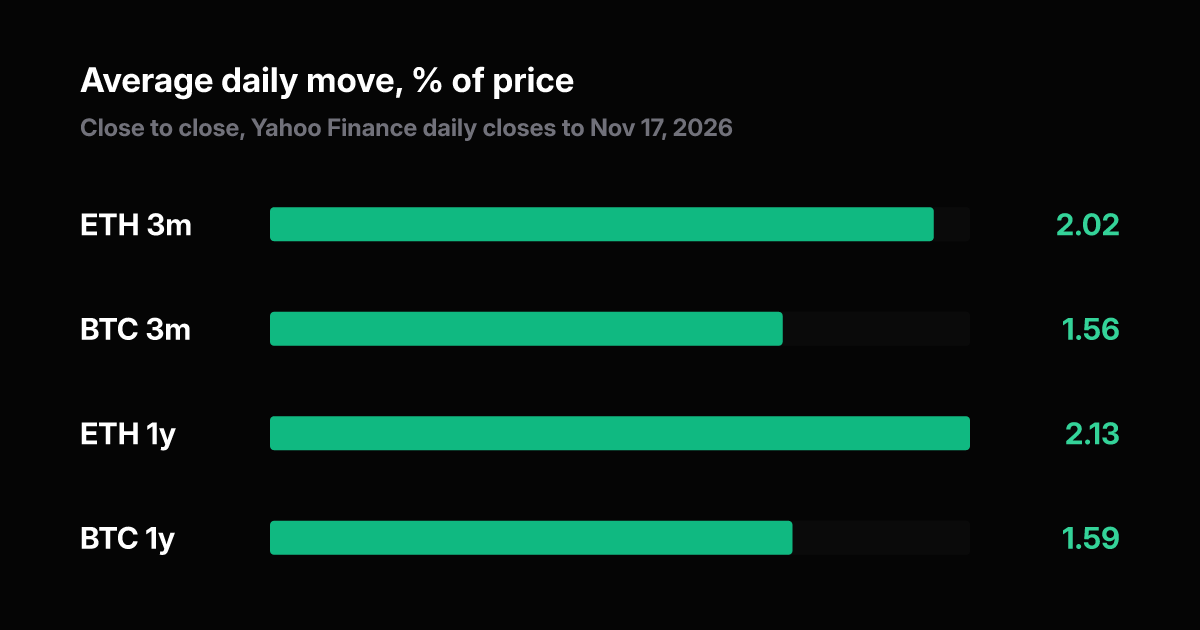
That percent gap matters for sizing. A stop that sits outside one average day was 1.86% of price on bitcoin but 2.60% on ether, so for the same dollar risk the ether position ends up smaller in dollars, even though the lot number looks much bigger.
One formula for both coins
- Risk money: account equity × risk percent. $10,000 at 1% is $100.
- Stop in dollars: entry price minus stop price, in full dollars of the coin.
- Lots: risk money ÷ stop in dollars (because 1.0 lot pays $1 per $1).
- Round down to your broker's volume step, usually 0.01.
Worked example with a stop one average day away (3 month averages above), on a $10,000 account at 1%:
| Step | BTCUSD | ETHUSD |
|---|---|---|
| Risk money | $100 | $100 |
| Stop | $1,205.45 | $47.38 |
| Raw lots | 0.083 | 2.11 |
| Rounded lots | 0.08 | 2.11 |
| Real risk | $96.44 | $99.97 |
| Position at Nov 17 close | $5,191.52 | $3,846.45 |
Same risk, very different lot numbers: 0.08 against 2.11. Typing 0.08 on ETHUSD would risk under $4, and typing 2.11 on BTCUSD would risk about $2,540, more than 25% of the account. That mix up is the most expensive mistake when you switch between the two symbols. Check the plan with the position size calculator and the risk reward calculator before the order.
ETHUSD vs BTCUSD lot size tables at 1% risk
Stops are one and two average days from the three months to November 17, 2026: $1,205.45 and $2,410.91 on bitcoin, $47.38 and $94.75 on ether. Lots are rounded down to 0.01.
| Account | 1% risk | BTC 1 day stop | BTC 2 day stop | ETH 1 day stop | ETH 2 day stop |
|---|---|---|---|---|---|
| $1,000 | $10 | below 0.01 | below 0.01 | 0.21 | 0.10 |
| $5,000 | $50 | 0.04 | 0.02 | 1.05 | 0.52 |
| $10,000 | $100 | 0.08 | 0.04 | 2.11 | 1.05 |
| $25,000 | $250 | 0.20 | 0.10 | 5.27 | 2.63 |
For the account by account logic on small balances, see how many lots you can trade with $1,000, and for the full bitcoin walkthrough read the BTCUSD lot size guide.
The minimum lot problem: why small accounts fit ether better
Most brokers stop at 0.01 lot. On bitcoin, 0.01 lot with a one average day stop risks $12.05, so a 1% rule needs at least about $1,205 of equity. On a $1,000 account that same trade is 1.2% risk, and a two day stop is 2.4%. On ether, 0.01 lot with a one average day stop risks $0.47, so even a few hundred dollars can size it at 1% with room to spare.
Ether gives you finer steps, not a safer market: it moved more in percent over both windows and had the single biggest day of the two coins (17.48% on August 19, 2026). If the chart needs a stop your account cannot fit at 0.01 lot, skip the trade or knowingly accept the larger percent. Do not shrink the stop to make the lot fit.
Trading both at once: a 0.91 correlation means one bet
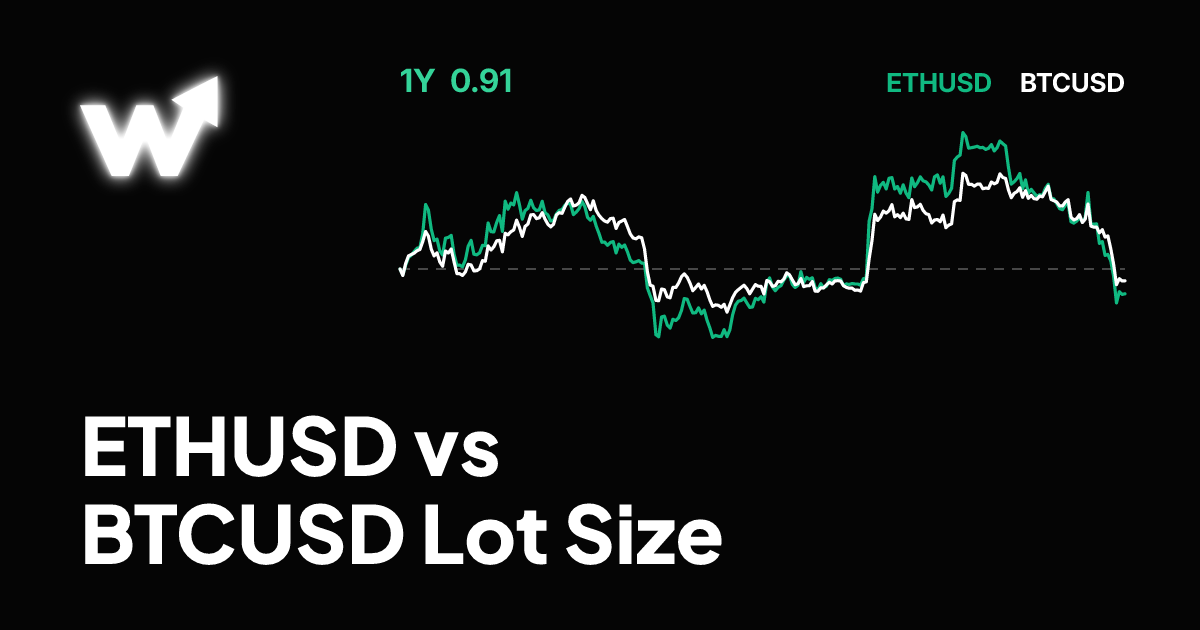
We computed the correlation of daily percent changes from the same closes: 0.91 over one year, 0.90 over three months and 0.94 over the last 30 days. Moves that close to 1 mean ether and bitcoin usually go the same way on the same day. The ETH to BTC price ratio still fell from 0.0336 to 0.0281 over the year, so ether lost more on the way down.
If you buy a full 1% position in each, you are closer to one 2% bet on crypto than to two separate trades. Split the risk instead, for example 0.5% on each, or pick the cleaner chart. Check the live BTC vs ETH correlation before stacking them, and read how to use correlation for the method.
Margin: what each lot ties up
Margin does not change your lot size, but it decides whether the order opens. ESMA's CFD rules for retail clients cap crypto leverage at 2:1, so margin is half the position. At the November 17 closes:
| Lot size | BTCUSD margin at 2:1 | ETHUSD margin at 2:1 |
|---|---|---|
| 0.01 | $324.47 | $9.11 |
| 0.10 | $3,244.70 | $91.15 |
| 1.00 | $32,446.97 | $911.48 |
Outside those rules leverage can be higher, but the risk per dollar moved is the same. Size from the stop, then check that free margin covers the order.
ETHUSD or BTCUSD: which is easier to size?
- Small account: ETHUSD, because 0.01 lot is a much smaller step in dollars.
- Lower volatility in percent: BTCUSD, 1.56% against 2.02% on an average day over three months.
- Same lot math: both pay $1 per $1 per 1.0 lot on the usual preset.
- Both together: treat them as one position because of the 0.91 correlation.
Before the first live order, open Specification on your platform and confirm contract size, profit currency, minimum volume and volume step, because some brokers use a different crypto contract. Then plan the exit with a fixed risk reward ratio and look for clean setups such as a bull flag. For another side by side guide, see US30 vs NAS100 and the lots calculator hub.
Frequently Asked Questions
Is 1 lot of ETHUSD the same as 1 lot of BTCUSD?
The contract works the same way: on the usual preset (contract size 1, profit in USD) 1.0 lot is one coin and pays $1 per $1 move. The money behind it is not the same. At the November 17, 2026 closes, 1.0 lot of BTCUSD was a $64,893.95 position and 1.0 lot of ETHUSD was $1,822.96.
How much is 0.01 lot of ETHUSD worth?
0.01 lot of ETHUSD is 0.01 ether, so it pays $0.01 per $1 move. At the November 17, 2026 close of $1,822.96 it was an $18.23 position, and an average ether day over the prior three months ($47.38) changed it by about $0.47.
How much is 0.01 lot of BTCUSD worth?
0.01 lot of BTCUSD is 0.01 bitcoin, so it pays $0.01 per $1 move. At the November 17, 2026 close of $64,893.95 it was a $648.94 position, and an average bitcoin day over the prior three months ($1,205.45) changed it by about $12.05.
How do I calculate ETHUSD or BTCUSD lot size?
Lots = (account equity × risk percent) ÷ stop distance in dollars, then round down to the 0.01 step. Example: $10,000 at 1% is $100. With a $47.38 ether stop that is 2.11 lots of ETHUSD; with a $1,205.45 bitcoin stop it is 0.08 lot of BTCUSD.
Does ether move more than bitcoin?
In percent, yes, over the period we measured. Close to close, ether averaged 2.02% a day over the three months to November 17, 2026 and 2.13% over one year, against 1.56% and 1.59% for bitcoin. In dollars bitcoin moves far more because its price is about 35.6 times higher.
Can I trade ETHUSD and BTCUSD at the same time?
You can, but their daily changes were 0.91 correlated over the year to November 17, 2026 (0.90 over three months), so two full size positions behave like one larger bet. Split your usual risk between them or pick the cleaner setup.
Risk Disclaimer: Trading stocks, options, futures, forex, commodities, and cryptocurrencies involves substantial risk of loss and is not suitable for every investor. Past performance does not guarantee future results. This article is for educational purposes only and does not constitute financial advice. You should carefully consider your financial situation and risk tolerance before trading. Never trade with money you cannot afford to lose. Crypto CFD contract sizes, minimum volumes and leverage vary by broker and region. Confirm the Specification on your platform before sizing a live order. Statistics are calculated from Yahoo Finance daily closes for BTC-USD and ETH-USD and describe the past, not future moves.